
Building Control-ready PDF reports from £25 +VAT (£30 inc VAT) — covering every identical plot on the site.
Every paid PDF carries a printed report ID — Building Control can verify it in seconds.
Runs entirely in your browser. Autosaves as you work.
Never done one before? Read the how-to →
Issuing these to clients? Monkey Pro puts your practice on the report →
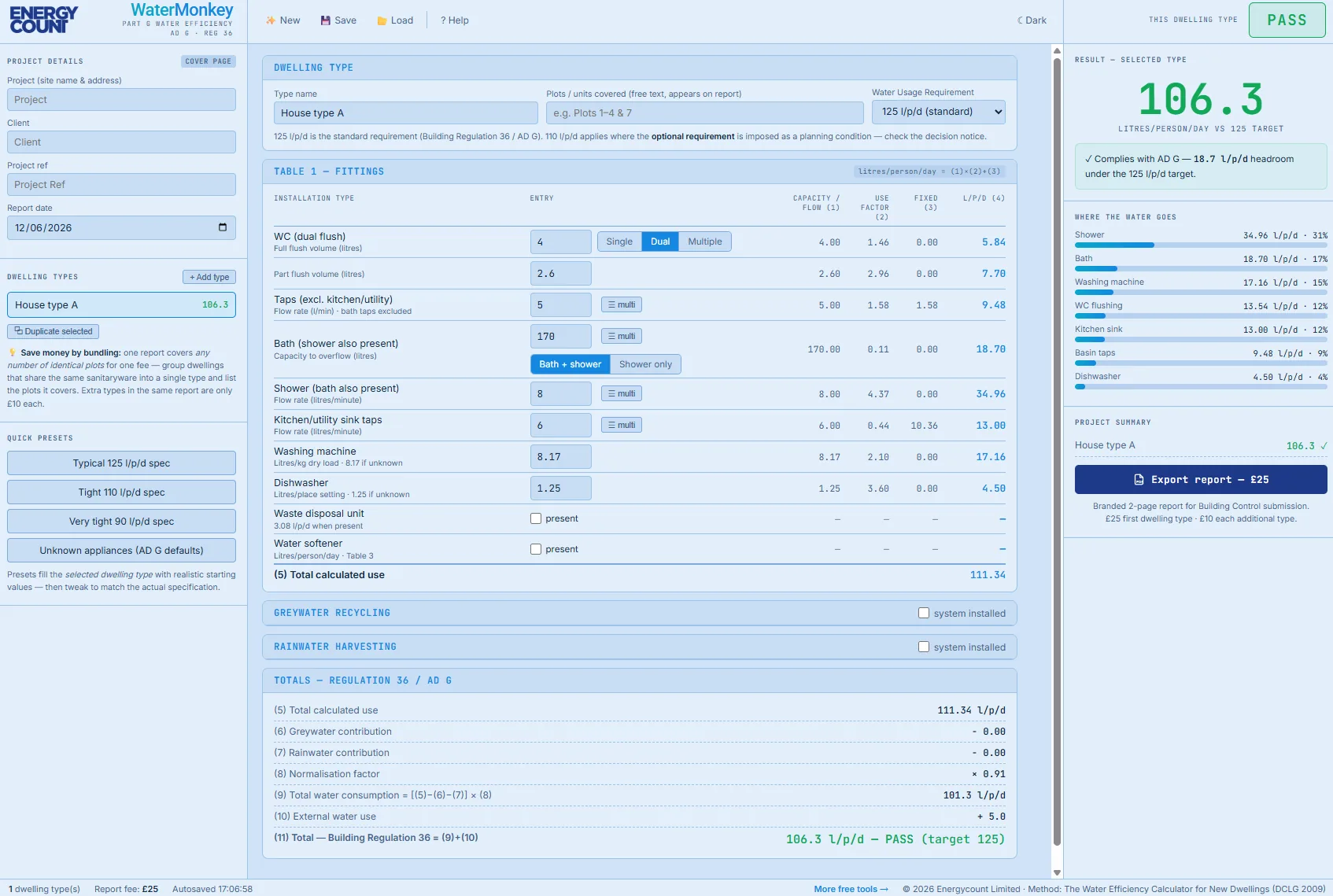 Watch the 28-second demo →
 Got a letter from Building Control?
If Building Control has asked you for a "water efficiency calculation", a "Part G water calculation" or a "water efficiency certificate" for your new build, conversion or self-build — this is that, and you can do it yourself. No qualifications needed, no site visit, no survey: just the spec sheets of the taps, showers, bath and WCs you're fitting. There is no such thing as a statutory water efficiency certificate, as it happens — here is what the regulations actually require, if you want the background first.
What it costs elsewhere
Online services and assessors typically charge £25–£65 for a single calculation — and again for every different house type on your site. WaterMonkey is free to use: build your fittings schedule, see PASS/FAIL live, adjust until it's right. You pay £25 +VAT only when you export the report, one fee covers every identical plot, and extra house types are £15 +VAT rather than full price. For anything beyond a single dwelling, it's not close.
What a Part G water calculation has to show
Regulation 36 of the Building Regulations 2010 puts it in one sentence: the potential consumption of wholesome water by the people occupying a new dwelling must not exceed the requirement — in England, no more than 125 litres per person per day under Part G, or 110 l/p/d where planning imposes the optional tighter standard, which is also what a London scheme needs. Wales has its own version of regulation 36: 110 l/p/d for a newly built dwelling and 125 l/p/d for one formed by a conversion, with no planning condition involved. WaterMonkey's requirement menu has both. "Potential consumption" is the giveaway: nobody meters you. The figure is calculated from the fittings you install, using the methodology set out in Approved Document G — originally published as The Water Efficiency Calculator for New Dwellings and now carried inside AD G itself.
This Part G calculator implements that methodology in full: Table 1 use factors, multiple-fittings averaging, the water softener rule, and rainwater and greywater systems to BS 8515. Nothing is approximated and nothing is rounded in your favour — the report shows every line so Building Control can check the working.
Fitting by fitting
Every line behaves differently, and the differences are larger than most specifications assume — a litre per minute off the shower is worth ten times a litre off the kitchen tap. Pick the one you're about to change:
Want the whole method laid out, with a worked example from fittings schedule to final figure? The spreadsheet version, and why you don't need one.
How it works
- Enter your fittings — taps, showers, baths, WCs, white goods; pick a preset and tweak, with live PASS/FAIL as you go.
- See where the water goes — a live breakdown plus practical tips to get under target without downgrading the master shower.
- Add dwelling types — one type covers all identical plots; duplicate and adjust for each different spec, with a per-type plot schedule.
- Export when ready — a branded, Building Control-ready PDF: cover page, results table, PASS/FAIL, and a fittings page per dwelling type.
Pricing that rewards real sites
£25 +VAT (£30 inc VAT) for the report including your first dwelling type, then £15 +VAT per additional type — and a type covers every identical plot free. Typical online services charge £25–£65 per calculation, so for a mixed-type development WaterMonkey is usually the cheapest option by a wide margin. In plain numbers: forty identical plots is one £25 +VAT report; ten plots across two house types is £40 +VAT all in. Using it is free; you only pay for the PDF.
Who it's for
Developers and builders who need the water calc for Building Control sign-off; architects checking a sanitaryware spec before it's ordered; SAP assessors bundling water calcs with their assessments (shower flow rates now feed SAP 10 too). Rather we did it for you? Our Part G service has you covered.
What else this dwelling needs
Part G applies to new dwellings only, so if you are running this calculation the same dwelling also has to satisfy Part L — and that is a bigger piece of work than the water calc. It means a SAP calculation at design stage, before work starts, a second as-built SAP once it is finished, the BREL report with its plot-by-plot photographic evidence, and the EPC on completion. Building Control will not sign the dwelling off without them.
That one needs an accredited assessor — there is no free calculator for it, here or anywhere else. We do it: SAP calculations and EPCs from your drawings, including the new build route and the full compliance pack.
Issue it as your own document — Monkey Pro
The calculator is free and always will be. Monkey Pro is for practices that issue these reports to clients rather than just checking a number: your logo, practice name, address and contact lead the header of every Part G water efficiency report, the Energycount wordmark drops to a small credit line, and each report carries your project number and revision.
- Your practice on the header — logo, practice name, address and contact
- Project number and revision on every report, so Building Control resubmissions track properly
- No Energycount marketing — it is your document, not an advert for ours
- Set up once — your details live on your account, not re-typed on every job
- One plan, every tool — the same branding on your soakaway, thermal bridge, U-value and condensation reports
See what Pro puts on a report — £10/month +VAT Or £100/year. Cancel any time, online. Report prices are unchanged — Pro is the branding, not a discount.
Frequently asked questions
I'm a self-builder, not an assessor — can I really do this myself?
Yes. The calculation is a paper exercise based on your fittings' specifications — no surveys, no site visits, no special qualifications. If you can find the flow rate on a tap's spec sheet, you can do this. WaterMonkey handles all the official maths and tells you instantly whether you pass.
What do I need before I start?
The spec details of your fittings: tap and shower flow rates (litres/minute), bath capacity, WC flush volumes, and dishwasher/washing machine consumption if specified. All of it is on product spec sheets or retailer listings. Ten minutes of gathering, ten minutes of entering.
What is a Part G water calculation?
The water efficiency calculation required by Building Regulation 36 and Approved Document G for every new dwelling, using the official methodology (The Water Efficiency Calculator for New Dwellings). In England it must show calculated consumption of no more than 125 litres per person per day — or 110 l/p/d where a planning condition imposes the optional tighter standard. In Wales the limit is 110 l/p/d for a new-build dwelling and 125 l/p/d for one formed by a conversion.
Is WaterMonkey free to use?
Yes — building your fittings schedule, checking PASS/FAIL against the English or Welsh requirement (125 or 110 l/p/d) or a custom target, and exploring what gets you under is all free in the browser. You pay only to export the Building Control-ready PDF report: £25 +VAT (£30 inc VAT), which includes your first dwelling type.
Does WaterMonkey work offline — can I install it as an app?
Yes. WaterMonkey installs on your phone or desktop like an app — use the install icon in your browser's address bar, or Add to Home Screen on iOS — and the calculator then works fully offline. Your work autosaves in this browser; you only need a connection when you export the paid PDF.
How does pricing work for multiple house types?
One dwelling type covers every identical plot on the site at no extra cost — a 40-plot site with one spec is still £25 +VAT. Each additional dwelling type (different fittings spec) is £15 +VAT. Most online services charge per calculation, so mixed-type sites cost a fraction of the usual price here.
Does it follow the official methodology?
Yes — the full DCLG Water Efficiency Calculator methodology: Table 1 use factors, Table 2 multiple-fittings averaging, the Table 3 water softener rule, and greywater/rainwater systems to BS 8515 (Tables 4.6, 5.1, 5.2 and 5.5). Results are verified against our in-house Excel masters.
Can I include rainwater or greywater harvesting?
Yes — both, using BS 8515 intermediate calculations or direct entry, with savings correctly capped against demand and protection against double-counting WC demand across the two systems.
Can I re-export after fixing a typo?
Yes — project details (project name, client, reference, plot schedule) can be changed and re-exported free for 24 hours after payment. Changing the actual fittings calculations requires a new export.
Can I get a refund if something goes wrong?
Yes — our refund practice is deliberately generous. An undelivered report refunds automatically, normally within the hour. If a report is faulty — it doesn't match your inputs or misapplies the stated methodology — we'll repair, replace or refund it under the Consumer Rights Act 2015, and minor corrections can be re-exported free for 24 hours after purchase.
Will Building Control accept the report?
It follows the official methodology (The Water Efficiency Calculator for New Dwellings) in full and shows the complete fittings schedule and working, so a building control body can check every line. Every paid report also carries a printed report ID that can be verified in seconds at energycount.co.uk/verify — and if anything raises a question, we're a real consultancy on 01202 623236, not just a website.
Can the report be issued at design stage or as-built?
Yes — choose under Project details → Report stage, or in the export dialog. Design stage, the default, is worded for the proposed specification, which is what most building control bodies want with the plans. As-built is worded for the dwelling as constructed, from the fittings actually installed, and gives the two figures the Regulation 37 notice needs at completion: the requirement that applies and the calculated consumption. An as-built report can also list the make and model of every fitting installed. The stage changes the wording, never a figure.
Where the method comes from
WaterMonkey is not a rule of thumb or an in-house estimate. It runs the published statutory methodology, and these are the documents it implements — worth a read if you want to check the working yourself.
- Approved Document G — sanitation, hot water safety and water efficiency The statutory guidance. Paragraph 2.2 points you at Appendix A, "Water efficiency calculator for new dwellings" — the methodology this tool implements, use factors and fittings definitions included.
- The Building Regulations 2010, regulation 36 — water efficiency of new dwellings The requirement itself, in separate versions for England and Wales. England: potential consumption of wholesome water not to exceed 125 l/p/d, or 110 l/p/d where a planning condition imposes the optional requirement. Wales: 110 l/p/d where a dwelling is erected, 125 l/p/d where it is formed by a material change of use.
- The Building Regulations 2010, regulation 37 — wholesome water consumption calculation The notice duty: the notice must specify which requirement applies and the calculated consumption per person, and reach the building control authority no later than five days after the work is completed — or accompany the completion certificate application for a higher-risk building. Since 1 October 2023 the notice goes to the building control authority, not the local authority.
- The Water Efficiency Calculator for New Dwellings (DCLG, 2009) The original publication of the methodology. Withdrawn on gov.uk in June 2016 because the method now lives in Approved Document G — the calculation is unchanged, and Building Control still call it by this name.