
Building Control-ready PDF reports £25 +VAT (£30 inc VAT) — percolation, storm table and dimensioned result.
Every paid PDF carries a printed report ID — Building Control can verify it in seconds.
Runs entirely in your browser. See the size update as you work.
Never sized one before? Read the how-to →
Issuing these to clients? Monkey Pro puts your practice on the report →
 Watch the 17-second demo →
 Been asked for a soakaway design?
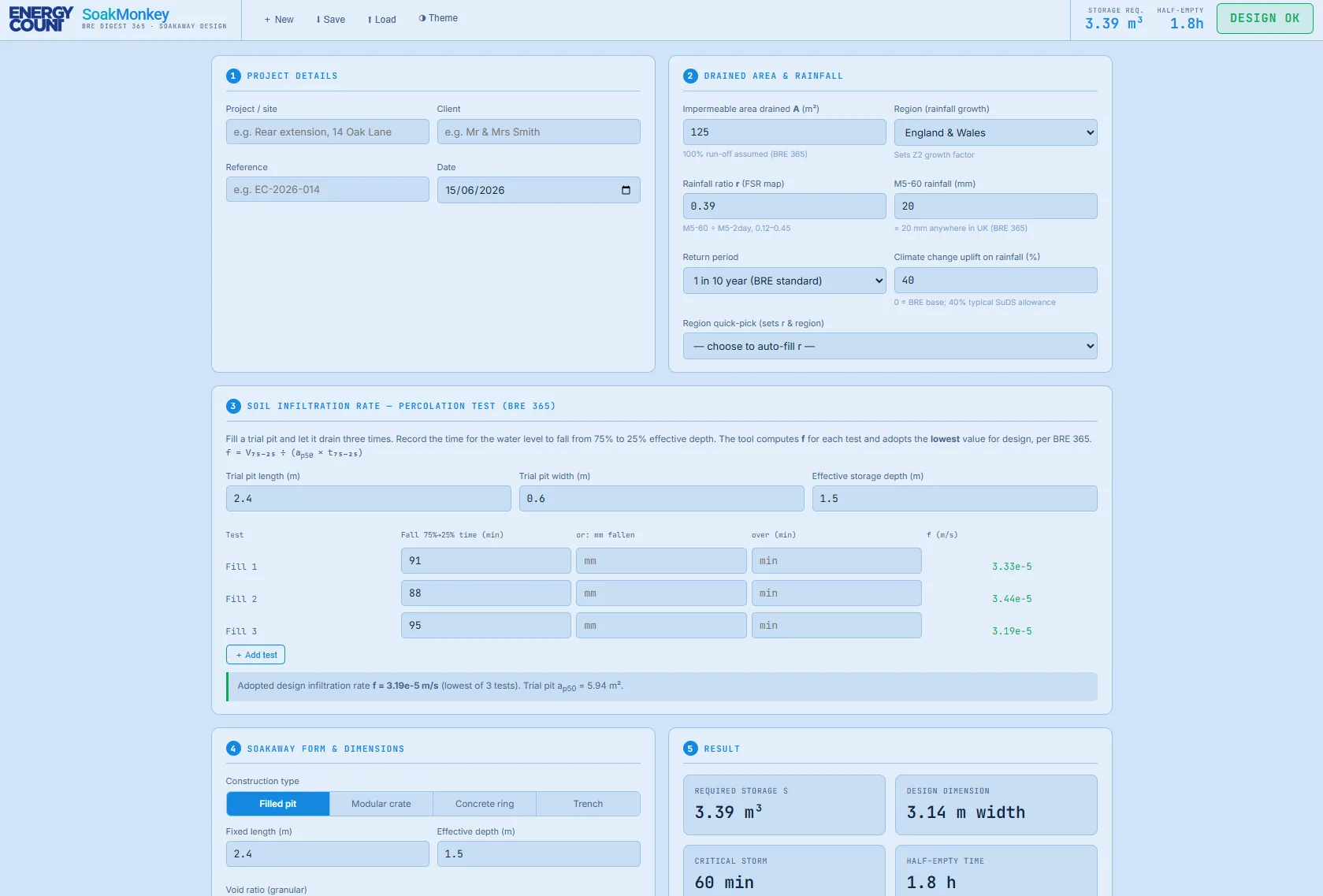
If Building Control or your drainage strategy needs a soakaway sized "to BRE 365", this is that — and you can do it yourself. Run a percolation test, enter the three fills and the area draining to the soakaway, and SoakMonkey does the rest: infiltration rate, storm analysis and the dimensions you need. No surveyor, no specialist software. What building control needs to see sets out the rules behind it, the test and what the report has to show.
What it costs elsewhere
A consultant soakaway design typically runs to a few hundred pounds. SoakMonkey is free to use — size it, try a crate against a trench, see what fits your plot — and the £25 +VAT only applies when you export the Building Control-ready PDF. If you'd rather hand it over entirely, just ask us.
The method Building Control expects
SoakMonkey implements BRE Digest 365 in full: it computes the soil infiltration rate from your three percolation test fills and adopts the lowest, runs the FSR design rainfall across eight storm durations, and sizes four construction types — filled granular pit, modular crate, perforated concrete ring and trench — with the worst case governing. An optional climate-change uplift and the 24-hour half-drain check are built in.
Sizing a specific soakaway
Jump straight to your situation:
- Soakaway for a house extension
- What size soakaway do I need?
- Crate soakaway — and how many crates you need
- Concrete ring soakaway
- Rubble / gravel soakaway
- Soakaway trench
- The BRE 365 calculation as a spreadsheet, row by row
- Wales: soakaway design for SAB approval
- Scotland: the clause 3.6.5 formula and BRE 365 for a building warrant
How it works
- Enter your percolation test — three fills; the tool finds the infiltration rate and adopts the lowest per BRE 365.
- Add the catchment — the area draining to the soakaway and your rainfall region (auto-filled from the FSR data).
- Pick a construction — pit, crate, concrete ring or trench; each solved across eight storms, worst case wins.
- Export when ready — a branded, Building Control-ready PDF with your inputs, the percolation analysis, the storm table and the dimensioned result.
Who it's for
Self-builders and developers who need a soakaway design for Building Regs or a drainage condition; architects and engineers checking a sizing quickly; and anyone staring at a percolation test wondering what to do with the numbers. Want it done for you instead? We're happy to help.
Issue it as your own document — Monkey Pro
The calculator is free and always will be. Monkey Pro is for practices that issue these reports to clients rather than just checking a number: your logo, practice name, address and contact lead the header of every soakaway / SuDS report, the Energycount wordmark drops to a small credit line, and each report carries your project number and revision.
- Your practice on the header — logo, practice name, address and contact
- Project number and revision on every report, so Building Control resubmissions track properly
- No Energycount marketing — it is your document, not an advert for ours
- Set up once — your details live on your account, not re-typed on every job
- One plan, every tool — the same branding on your Part G, thermal bridge, U-value and condensation reports
See what Pro puts on a report — £10/month +VAT Or £100/year. Cancel any time, online. Report prices are unchanged — Pro is the branding, not a discount.
Frequently asked questions
What does the soakaway calculator actually work out?
It sizes a soakaway to BRE Digest 365 — the standard method Building Control and the Environment Agency expect. You enter your percolation (soakage) test results and the area draining to the soakaway, and it returns the dimensions needed to store and discharge a 1-in-10-year storm without flooding.
I've done a percolation test — what do I enter?
Your three test fills. SoakMonkey computes the soil infiltration rate (f) from each and adopts the lowest, exactly as BRE 365 requires (the most conservative, safest result). If you haven't tested yet, the tool explains the three-fill method so you can run it on site.
Which soakaway types does it handle?
Four: a filled granular pit, a modular crate/cellular system (95% void), a perforated concrete ring soakaway, and a trench. Each is solved across eight storm durations and the worst case governs — so the size it gives you is the one that actually passes.
Does it allow for climate change?
Yes — there's an optional climate-change uplift on the design rainfall (default 40%) on top of the 1-in-10-year storm (or the 1-in-100-year storm, if you pick it), plus the BRE 365 half-drain-time check to confirm the soakaway empties within 24 hours.
Can it do a 1 in 100 year calculation?
Yes — pick 1 in 100 year as the return period. Same BRE Digest 365 method and inputs, with the 100-year growth factors from Table 2 of the digest's 2016 edition, so the soakaway is sized to hold the 1 in 100 year storm plus your climate-change uplift. That is what a planning condition or the lead local flood authority usually means by a 1 in 100 year calculation; Building Regulations only ask for 1 in 10. For a planning SuDS statement under NPPF policy F8, use the England planning option instead — it adds the National Standards’ factor of safety and 24-hour rule.
Can I use FEH rainfall instead of FSR?
Yes — switch Rainfall data to FEH and type in the site's depths from the FEH Web Service, 15 minutes to 24 hours, before climate change. SoakMonkey runs the same BRE Digest 365 volume balance on them, at 1 in 10 or 1 in 100 years, and prints the depths and their source in the report. Some lead local flood authorities now ask for FEH rather than FSR, particularly for a 1 in 100 year design.
Does it cover NPPF policy F8 and the National Standards for SuDS?
Yes — pick “England — planning: NPPF policy F8” in step 1. Since August 2026, policy F8 asks any development that could affect drainage for sustainable drainage designed to Defra’s National Standards for Sustainable Drainage Systems. SoakMonkey then checks the soakaway against Standard 3: the site’s 1 in 30 and 1 in 100 year rainfall depths with the upper-end climate allowance, the Table S3.1 factor of safety on the infiltration rate, and half-emptying within 24 hours. The report cites the standards it applies. The rest of a SuDS statement — where the water goes, water quality and maintenance — is yours to add, using the Environment Agency’s SuDS Strategy Template.
Is SoakMonkey free, and what does the report cost?
The calculator is free to use in your browser — enter your test data, size the soakaway, try different constructions. You only pay to export the PDF report: £25 +VAT (£30 inc VAT), ready to submit with your drainage strategy or Building Regs application.
Can I use SoakMonkey on site?
Yes — it installs on your phone like an app and works fully offline, and there's a built-in percolation stopwatch: time each 75%→25% fall at the trial pit and the result is written straight into the calculation.
Is the method reliable?
It implements BRE Digest 365 in full, with the FSR rainfall data built in, and has been checked against every worked example in the digest — Shropshire, Southampton, the concrete-ring and trench cases all reproduce exactly.
Can I get a refund if something goes wrong?
Yes — our refund practice is deliberately generous. An undelivered report refunds automatically, normally within the hour. If a report is faulty — it doesn't match your inputs or misapplies the stated methodology — we'll repair, replace or refund it under the Consumer Rights Act 2015, and minor corrections can be re-exported free for 24 hours after purchase.
Will Building Control accept the report?
It follows BRE Digest 365 in full — percolation analysis, storm-duration table and the half-drain check — so a building control body can see the complete working. Every paid report also carries a printed report ID that can be verified in seconds at energycount.co.uk/verify — and if anything raises a question, we're a real consultancy on 01202 623236, not just a website.
Where the method comes from
SoakMonkey sizes to the published method, not to a rule of thumb. These are the documents behind it.
- Approved Document H: drainage and waste disposal Section H3 is the surface water drainage requirement, and the reason a soakaway has to be sized and evidenced rather than guessed.
- National standards for sustainable drainage systems (SuDS) The design, maintenance and operation standards that NPPF policy F8 has asked of development affecting drainage since August 2026. SoakMonkey’s England planning option checks a soakaway against Standard 3.