
Planning-ready PDF reports £79 +VAT (£94.80 inc VAT) — nitrogen, phosphorus, or both nutrients in one report.
Every paid PDF carries a printed report ID — Building Control can verify it in seconds.
Runs entirely in your browser. See your budget update as you work.
Never done one before? Read the how-to →
Issuing these to clients? Monkey Pro puts your practice on the report →
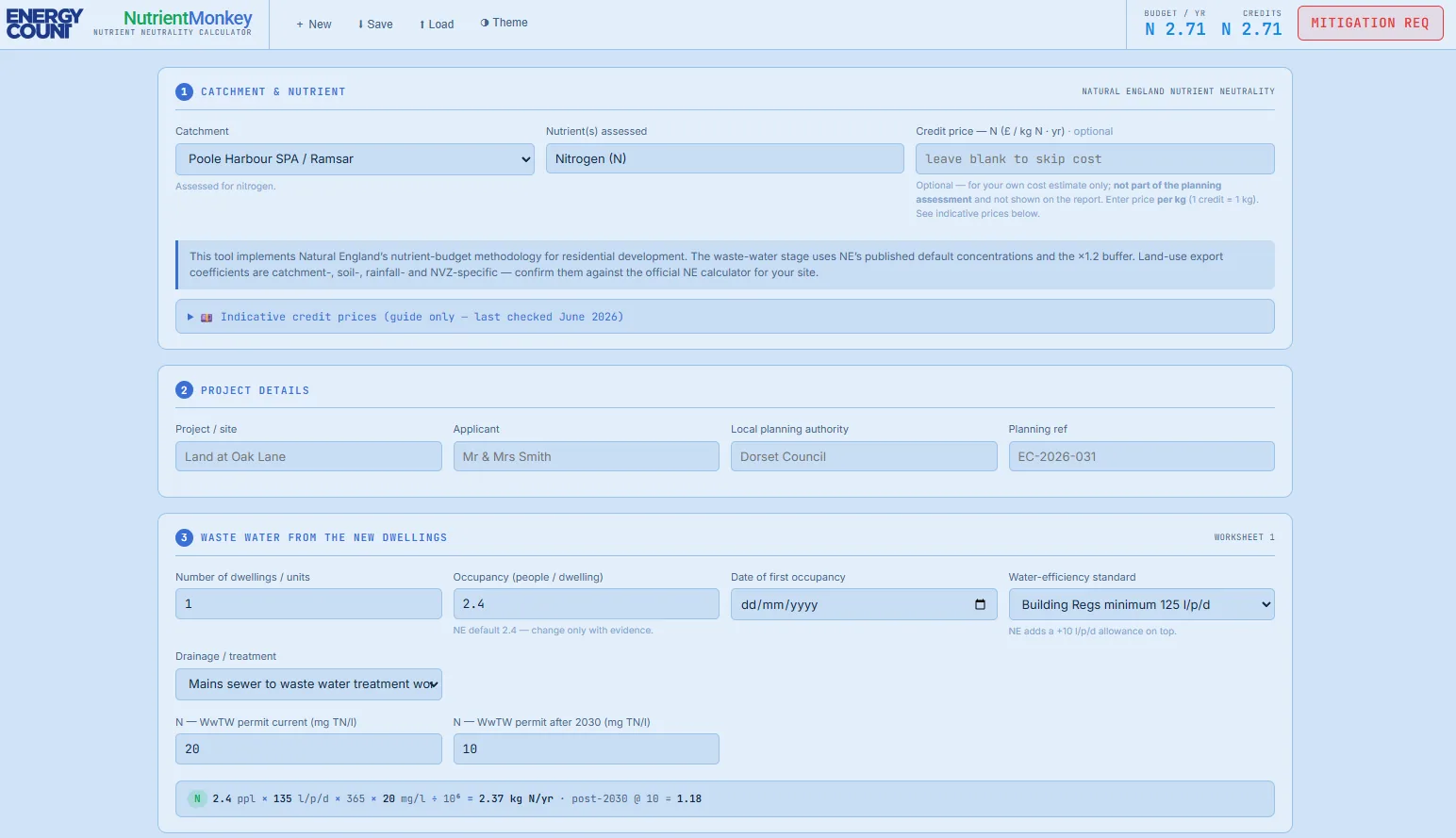 Watch the 23-second demo →
 Stuck behind a nutrient neutrality condition?
If your site sits in one of Natural England's protected catchments, the planning authority can't grant permission until you've shown your scheme is "nutrient neutral" — that it won't add nitrogen or phosphorus to waters that are already overloaded. That's the wall a lot of small developments hit. NutrientMonkey gets you over it: build the assessment on screen, watch your budget in kg/year update as you go, and export the report when it's right. What the council needs before it can grant permission sets out the whole route, from the budget to securing the credits.
What is a nutrient neutrality assessment?
It is what the planning authority asks for when your site sits in one of Natural England’s protected catchments: a nutrient budget in kg/year for the nutrient that applies, worked through NE’s published methodology with the ×1.2 precautionary buffer, together with evidence that anything left over is mitigated. Two halves, in other words — the calculation, and what you are doing about the shortfall. NutrientMonkey does the first half in full for all 27 catchments and sizes the second: the budget, the pre- and post-2030 figures where a treatment permit tightens, and the credits you would need in kg. Most schemes that stall, stall on the arithmetic — and that is the part you can settle here in a few minutes, free, before you go near a credit price. Need it prepared and signed off by a consultant instead? That is our nutrient neutrality assessment service.
What it costs elsewhere
Consultant nutrient assessments routinely run into the hundreds of pounds per scheme. NutrientMonkey is free to use — model the dwellings, the waste-water route and any SuDS, and see the budget live. You pay £79 +VAT only when you export the planning-ready PDF. If you'd sooner we just did the whole thing for you, we prepare nutrient neutrality assessments too.
The calculation planning wants
NutrientMonkey reproduces Natural England's own catchment calculators (NECR459 and the calculator workbooks) — the five-worksheet flow condensed onto one page: waste water, current land use, future land use, SuDS, then the final budget with the precautionary ×1.2 (20%) buffer. NE's treatment-works permits, NE's land-use lookups, the 90%-of-permit rule and NE's rounding are all built in and checked against the workbooks themselves, so your budget reproduces in NE's calculator exactly. Off-mains, on-mains and post-2030 permit scenarios are all handled.
How it works
- Pick your catchment — all 27 are in the list, each flagged nitrogen, phosphorus or both; the nutrient toggle locks itself to match.
- Enter the dwellings & waste water — occupancy, water use (110 or 125 l/p/d plus NE's allowance) and the drainage route (septic, package plant or mains). On mains, pick the treatment works and its permits fill in from NE's own lookup.
- Add land use & SuDS — current vs future land cover and any sustainable drainage. Set the soil type and Natural England's own export coefficients for the catchment fill in.
- Export when ready — a branded, planning-ready PDF: the budget in kg/year, every input, a colour-coded section per nutrient where both apply, and a page of exactly what to enter in NE's own calculator to get the same figures.
Know your harbour
The nutrient that applies isn't always the obvious one. Chichester Harbour falls inside the Solent (nitrogen); Christchurch Harbour is the River Avon SAC (phosphorus) — a different nutrient from neighbouring Poole Harbour, which is nitrogen. Dual-nutrient catchments such as Stodmarsh and The Broads need both, and NutrientMonkey runs the two budgets together (each with its own credits, exactly as NE's own calculator is run).
Honest about what it is
This is a nutrient-methodology assessment built to support your planning application — fast, clear, and ready to discuss with your case officer. The official Natural England catchment calculator remains the statutory tool. Your figures reproduce in it, and the report lists the values to enter and the figure NE's calculator returns. We'd rather tell you that up front than dress it up as something it isn't.
What's changing: the Nature Restoration Fund
Nutrient neutrality is in the middle of its biggest shake-up since 2019. The Planning and Infrastructure Act 2025 (Royal Assent December 2025) introduces Environmental Delivery Plans funded through a Nature Restoration Fund: instead of sourcing their own mitigation scheme by scheme, developers will be able to pay a Nature Restoration Levy to Natural England, which delivers the mitigation strategically across a whole area. The secondary legislation is now in place: the Environmental Delivery Plans (Appropriate Prioritisation) Regulations 2026 came into force on 9 July 2026, and the Nature Restoration Levy Regulations 2026 on 11 September 2026. The first plan, the draft Norfolk Environmental Delivery Plan, went out to consultation on 17 September 2026: it covers the River Wensum and the Bure and Yare Broads catchments, at a proposed levy of £2,675 per home, and it is not yet in force. Natural England is preparing 16 nutrient EDPs in all. Until an EDP is in force for your catchment the existing regime still applies — you calculate the budget and secure mitigation exactly as now — so NutrientMonkey's methodology is unchanged. We track these changes and will update the tool as EDPs go live.
Who it's for
Developers and self-builders who've hit a nutrient neutrality condition and want to understand their budget before committing to credits; architects and planning consultants pricing up a scheme; and anyone who needs a clear, defensible nutrient figure to put in front of a planning authority. Want it handled end to end? That's what we're here for.
From budget to credits
Once the budget is above zero, the question becomes how many credits and at what price. The nutrient credits calculator takes the pre- and post-2030 figures, gives the credits you need and an indicative cost, with the published price prefilled for the catchments that have one.
Find your catchment
Not sure whether your site is in one? Check the catchment map — all 27 on one map of England, coloured by the nutrient that applies. Need the permit consent at the works your scheme drains to? That is in the wastewater permit register — 675 works, free.
Every Natural England catchment has its own page with the nutrient that applies and a calculator set up for it. Jump straight to yours:
- Poole Harbour N
- Solent N
- Tees (Teesmouth) N
- Lindisfarne N
- Stodmarsh N & P
- The Broads N & P
- River Wensum N & P
- Chesil & the Fleet N & P
- Hornsea Mere N & P
- Oak Mere N & P
- Rostherne Mere N & P
- West Midlands Mosses N & P
- River Clun N & P
- River Avon (Christchurch) P
- Somerset Levels & Moors P
- River Itchen N & P
- River Axe P
- River Camel P
- Derwent & Bassenthwaite P
- River Eden P
- River Kent P
- River Lambourn P
- River Lugg P
- River Mease P
- Esthwaite Water P
- Peak District Dales P
- Roman Walls Loughs P
Issue it as your own document — Monkey Pro
The calculator is free and always will be. Monkey Pro is for practices that issue these reports to clients rather than just checking a number: your logo, practice name, address and contact lead the header of every nutrient neutrality assessment, the Energycount wordmark drops to a small credit line, and each report carries your project number and revision.
- Your practice on the header — logo, practice name, address and contact
- Project number and revision on every report, so Building Control resubmissions track properly
- No Energycount marketing — it is your document, not an advert for ours
- Set up once — your details live on your account, not re-typed on every job
- One plan, every tool — the same branding on your Part G, soakaway, U-value and thermal bridge reports
See what Pro puts on a report — £10/month +VAT Or £100/year. Cancel any time, online. Report prices are unchanged — Pro is the branding, not a discount.
Frequently asked questions
What is nutrient neutrality, and why has my planning been held up?
In certain catchments, new homes can't add nitrogen or phosphorus to already-overloaded protected waters. Natural England requires new dwellings there to be 'nutrient neutral' — so the planning authority can't grant permission until you've shown your scheme's nutrient budget and how any excess is offset. NutrientMonkey works out that budget for you.
What is a nutrient neutrality assessment?
It is what a planning authority asks for when your site is in one of Natural England's protected catchments: a nutrient budget in kg/year for the nutrient that applies — worked through NE's published methodology, including the ×1.2 precautionary buffer — together with evidence that any shortfall is mitigated. So it is a calculation plus a mitigation position. NutrientMonkey produces the calculation in full, for all 27 catchments, and sizes the shortfall in kg so you know how many credits you are shopping for. The official Natural England catchment calculator remains the statutory tool, and your figures reproduce in it.
Which catchments and nutrients does it cover?
All 27 Natural England catchments, each correctly flagged for nitrogen, phosphorus, or both. Nitrogen examples include Poole Harbour and the Solent (which covers Chichester Harbour); the River Avon SAC around Christchurch is phosphorus — a common trap, since it sits right next to nitrogen-led Poole. Dual-nutrient catchments like Stodmarsh and The Broads are assessed for both at once.
Is NutrientMonkey free to use?
Yes — building your assessment on screen and seeing your nutrient budget in kg/year is completely free. You only pay to export the planning-ready PDF report: £79 +VAT (£94.80 inc VAT).
Does it work offline — can I install it as an app?
Yes. NutrientMonkey installs on your phone or desktop like an app and works fully offline — your assessment autosaves in this browser, and you only need a connection when you export the paid PDF.
Is this the official Natural England calculator?
No — but it gives the same answer. NutrientMonkey reproduces Natural England's own catchment calculators: NE's treatment-works permits, NE's land-use lookups and NE's arithmetic, checked figure for figure against the calculator workbooks themselves. The official NE calculator remains the statutory tool, and the report says so — it lists exactly what to enter in NE's calculator for your catchment and the figure it returns, so your case officer can check it in a couple of minutes.
How is the nutrient budget actually calculated?
Exactly as NE's own calculator does it, condensed onto one page: waste water, current land use, future land use, SuDS, then the final budget with the ×1.2 (20%) precautionary buffer. For new dwellings the waste-water term dominates: occupancy × dwellings × water use (l/p/d) × 365.25 × the works' permit × 0.9 ÷ 1,000,000 — Natural England assumes a works discharges at 90% of its permit, and takes the no-permit defaults (27 mg/l nitrogen, 8 mg/l phosphorus) as they are. Defaults are 2.4 occupants and 110 l/p/d (125 where the tighter standard won't be conditioned) plus NE's 10 l/p/d allowance, with septic-tank, package-treatment-plant and mains-permit options built in. The land-use export coefficients are NE's own: set the soil type and they fill in.
How many credits will I need?
Where a treatment-works permit tightens (on 1 April 2030 at most works), NutrientMonkey gives you a pre-2030 and a post-2030 budget. If you buy permanent credits only, you need the greater of the two (floored at zero) — a permanent purchase sized to the higher pre-2030 load also covers the lower post-2030 load. Or you can split it: cheaper temporary credits (valid to 1 April 2030) for the pre-2030 excess, plus permanent credits for the enduring post-2030 baseline. The tool shows all three figures — pre, post and the permanent total — live, and one credit is 1 kg of nutrient per year. Credit prices vary hugely by scheme and aren't baked in; an on-screen panel lists indicative, dated prices where they're verifiable — official published prices now exist for Poole and Tees (Natural England), the Solent (Solent Mitigation Partnership), Stodmarsh (Stour Environmental Credits), the Broads & Wensum (Norfolk Environmental Credits), Somerset Levels & Moors (Somerset Council), the River Lugg (Herefordshire Council) and the four Cumbria catchments (Cumbria Nutrient Neutrality Partnership). Heads-up: schemes disagree on what 'a credit' means — NE uses 1 kg, some private schemes use 0.1 kg — so the tool works in £/kg.
Is nutrient neutrality changing with the Nature Restoration Fund?
Yes, but not yet in a way that changes your assessment today. The Planning and Infrastructure Act 2025 (Royal Assent December 2025) introduces Environmental Delivery Plans (EDPs) funded through a Nature Restoration Fund, where developers pay a Nature Restoration Levy to Natural England instead of sourcing their own mitigation. Natural England is preparing 16 nutrient EDPs. The secondary legislation is in place — the Appropriate Prioritisation Regulations came into force on 9 July 2026 and the Nature Restoration Levy Regulations on 11 September 2026 — and the first draft EDP, covering the River Wensum and the Bure and Yare Broads catchments at a proposed £2,675 per home, went out to consultation on 17 September 2026. It is a draft, not yet in force. Until an EDP is in force for your catchment, the existing nutrient-neutrality regime still applies — you calculate the budget and secure mitigation as now — so NutrientMonkey's methodology is unchanged. We'll update the tool as EDPs go live.
Can I re-export after fixing a typo?
Yes — project details can be corrected and re-exported free for 24 hours after payment. Changing the actual budget figures needs a new export.
Can I get a refund if something goes wrong?
Yes — our refund practice is deliberately generous. An undelivered report refunds automatically, normally within the hour. If a report is faulty — it doesn't match your inputs or misapplies the stated methodology — we'll repair, replace or refund it under the Consumer Rights Act 2015, and minor corrections can be re-exported free for 24 hours after purchase.
Will the planning authority accept the report?
It follows Natural England's published methodology for the catchment, with the full budget arithmetic shown, so the LPA's ecologist can check every line. Every paid report also carries a printed report ID that can be verified in seconds at energycount.co.uk/verify — and if anything raises a question, we're a real consultancy on 01202 623236, not just a website.
Where the method comes from
NutrientMonkey follows Natural England's published budget method for each affected catchment. These are the documents behind it.
- Using the nutrient neutrality calculators (Natural England) The official guidance and the table of all 27 affected catchments, with the five worksheets — wastewater, current land use, future land use, SuDS and the final budget — and the 20% buffer.
- Nutrient pollution: reducing the impact on protected sites The policy background: why habitats sites in these catchments need a nutrient budget before planning permission can be granted.