
E3 SAP / Approved Document L reference junction
Runs in your browser. No sign-up, no subscription — pay £25 +VAT only when you export the PDF.
What the window sill is
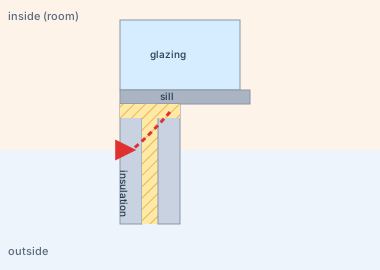
The sill is the horizontal junction at the bottom of a window or door opening, where the cavity is closed beneath the frame.
Why it matters
Like the jamb, the sill can bridge the inner and outer leaves where the cavity is closed, providing a heat path under the frame and a potential cold spot.
How to model it
Paint the wall, the sill detail, the cavity closer and the frame position. The insulation continuity beneath the frame governs the result.
Sill Ψ-values are usually modest but add up across many openings; calculating them alongside the jamb and lintel captures the whole opening.
What ΨMonkey solves this junction at
ΨMonkey's own results for its standard window sill template, with the external wall set to each of the assistant's eight named build-ups and everything else left at the template default. They are what the tool gives for those exact layers — not accredited values, and not your detail: a different block, a thicker board or a different lintel plate all move the number. Open any figure and the app loads that junction and wall with Ψ live; change what differs and read your own.
| Junction | Masonry, full fillU 0.18 | Masonry, partial fillU 0.28 | Timber frame, brickU 0.27 | TF brick + service voidU 0.26 | TF + 50 PIR sheathingU 0.16 | Timber frame, renderU 0.28 | Twin stud, 300 celluloseU 0.11 | CLT + EWIU 0.18 |
|---|---|---|---|---|---|---|---|---|
| E3Cill (window sill) | 0.0470.658 | 0.0370.652 | 0.0280.730 | 0.0430.648 | 0.0460.644 | 0.0270.729 | 0.0600.640 | 0.0390.643 |
Ψ in W/(m·K), with fRsi beneath — solved with Rsi 0.25 on internal surfaces, the BR 497 surface-temperature basis. Party-wall junctions (marked ½) show the per-dwelling Ψ, half the whole junction, which is the figure each SAP takes. Red is fRsi below 0.75, the BRE IP 1/06 condensation criterion for dwellings. Marked negatives on a non-inverted junction mean the template's default detail doesn't suit that wall — a prompt to model your own, not a figure to use. Click any figure to open that junction and wall in ΨMonkey with Ψ live.
The eight walls, and how these figures were produced
- Cavity masonry — full fill (accredited default)U 0.176 W/m²K100 mm Facing brick · 100 mm PIR insulation (foil-faced) · 100 mm Aerated concrete block (general) · 20 mm Plasterboard on dabs (12.5 + 15mm)
- Cavity masonry — partial fill + 50 mm clear cavityU 0.278 W/m²K100 mm Facing brick · 50 mm Air cavity (ISO 6946, ≥25mm) · 50 mm PIR insulation (foil-faced) · 100 mm Aerated concrete block (general) · 20 mm Plasterboard on dabs (12.5 + 15mm)
- Timber frame — brick clad, 140 mm studs (15% bridged)U 0.271 W/m²K100 mm Facing brick · 50 mm Air cavity (ISO 6946, ≥25mm) · 20 mm OSB/3 (18mm) · 140 mm Mineral wool (glass/rock) + 15% Structural timber · 20 mm Plasterboard on dabs (12.5 + 15mm)
- Timber frame — brick clad, 140 studs + service voidU 0.258 W/m²K100 mm Facing brick · 50 mm Air cavity (ISO 6946, ≥25mm) · 20 mm OSB/3 (18mm) · 140 mm Mineral wool (glass/rock) + 15% Structural timber · 25 mm Air cavity (ISO 6946, ≥25mm) + 9% Structural timber · 20 mm Plasterboard on dabs (12.5 + 15mm)
- Timber frame — 140 studs + 50 mm PIR over the sheathingU 0.163 W/m²K100 mm Facing brick · 50 mm Air cavity (ISO 6946, ≥25mm) · 50 mm PIR insulation (foil-faced) · 20 mm OSB/3 (18mm) · 140 mm Mineral wool (glass/rock) + 15% Structural timber · 25 mm Air cavity (ISO 6946, ≥25mm) + 9% Structural timber · 20 mm Plasterboard on dabs (12.5 + 15mm)
- Timber frame — render / rainscreen, 140 mm studsU 0.278 W/m²K20 mm External silicone render · 50 mm Air cavity (ISO 6946, ≥25mm) · 20 mm OSB/3 (18mm) · 140 mm Mineral wool (glass/rock) + 15% Structural timber · 20 mm Plasterboard on dabs (12.5 + 15mm)
- Closed panel / twin stud — 300 mm cellulose (8% bridged)U 0.112 W/m²K20 mm External silicone render · 50 mm Air cavity (ISO 6946, ≥25mm) · 60 mm Woodfibre board (Steico) · 300 mm Cellulose fibre (blown) + 8% Structural timber · 20 mm OSB/3 (18mm) · 20 mm Plasterboard on dabs (12.5 + 15mm)
- CLT + external insulation — 100 CLT, 160 woodfibreU 0.179 W/m²K20 mm External silicone render · 160 mm Woodfibre board (Steico) · 100 mm Cross-laminated timber (CLT) · 25 mm Air cavity (ISO 6946, ≥25mm) + 9% Structural timber · 20 mm Plasterboard on dabs (12.5 + 15mm)
Each figure is ΨMonkey's own result for its standard template of that junction, with the external wall set to the named build-up and every other element — floors, roofs, party walls, lintels, windows — at the template's shipped default. Boundary conditions to BS EN ISO 10211, Ti 20 °C / Te 0 °C, convergence 10⁻⁶. Solved 13 October 2026 on the app as shipped; regenerated whenever the app changes. How the solver itself is checked is on the validation page.
The full set on one page: the Ψ-value reference table.
Related build-ups: the U-values either side of this junction
The Ψ-value at the window sill depends on the walls, floors and roof around it — so the first step is knowing the U-values of those elements. Typical figures for the build-ups that pair with this junction:
- U-value of a cavity wall with full-fill insulation
- U-value of a solid brick wall with internal insulation
Model your exact build-up and read its U-value with the free U-Monkey calculator (PDFs included free), then come back here and solve the junction in ΨMonkey.
Free to model — no subscription
ΨMonkey isn't a monthly licence or a per-seat subscription. Build the window sill on the grid, solve it, and read the Ψ-value and fRsi on screen for nothing. You only pay £25 +VAT (£30 inc VAT), once, when you need the Building Control-ready PDF for that junction — so calculating a single detail never means signing up to anything. Calculated psi values are often the cheapest route to a SAP 10 pass, so the maths can pay for itself.
Frequently asked questions
What is the window sill (E3)?
The sill is the horizontal junction at the bottom of a window or door opening, where the cavity is closed beneath the frame. Like the jamb, the sill can bridge the inner and outer leaves where the cavity is closed, providing a heat path under the frame and a potential cold spot.
How do I calculate the window sill psi value?
Paint the wall, the sill detail, the cavity closer and the frame position. The insulation continuity beneath the frame governs the result. ΨMonkey solves it to BS EN ISO 10211 and returns the Ψ-value (W/m·K) and the f_Rsi temperature factor on screen, free.
Is it free, and is there a subscription?
No subscription and no licence — modelling the junction and reading off the Ψ-value is free in your browser. You only pay £25 +VAT (£30 inc VAT) when you export the Building Control-ready PDF for that junction.
What psi value should I expect for the window sill?
It depends on the wall. ΨMonkey's standard window sill template solves between 0.027 and 0.060 W/(m·K) across ΨMonkey's 8 standard walls, with everything else at the template defaults; on the accredited full-fill masonry wall that is E3 0.047 W/(m·K). Those are the tool's own results for those exact layers, not accredited values — open the junction with your wall preset from the table on this page and change what differs.
Can I use the result in a SAP or HEM assessment?
Yes — a calculated Ψ-value to ISO 10211 can replace the SAP default for this junction, and Sill Ψ-values are usually modest but add up across many openings; calculating them alongside the jamb and lintel captures the whole opening.
Other junctions
ΨMonkey models any junction. Jump to another common one:
- Wall-to-Floor Junction E5 / E19 / E22
- Window Jamb (Reveal) E4
- Lintel E1 / E2
- Eaves Junction E10 / E11 / E24
- Gable Junction E12 / E13
- External Corner E16
- Inverted Corner E17
- Intermediate Floor E6 / E7
- Party Wall Junction E18 / E25 / P1–P8
- Balcony Junction E8 / E9 / E23
- Exposed Floor E20 / E21
Related reading
- How we know ΨMonkey's numbers are right — BS EN ISO 10211 test reference results, published
- Thermal bridging explained — why junctions leak heat and how Ψ-values work
- What is a U-value? — the element-level heat loss this junction links
- SAP 10: what's new — how calculated Ψ-values beat defaults
- SAP calculations — put your Ψ-values to work in the full compliance model
- New Build Compliance Pack — SAP, water, acoustics and air in one